
Gravity Is Not Just Pulling, It Is Curving Space
By Katherine E.A. Korkidis
When you drop a ball, it falls.
When the Moon circles Earth, it stays in orbit.
For a long time, scientists explained this with a force called gravity. Gravity pulls objects together.
Einstein agreed that gravity makes objects move, but he described the “how” in a new way. He said gravity is connected to the shape of space itself.
The Fabric Model
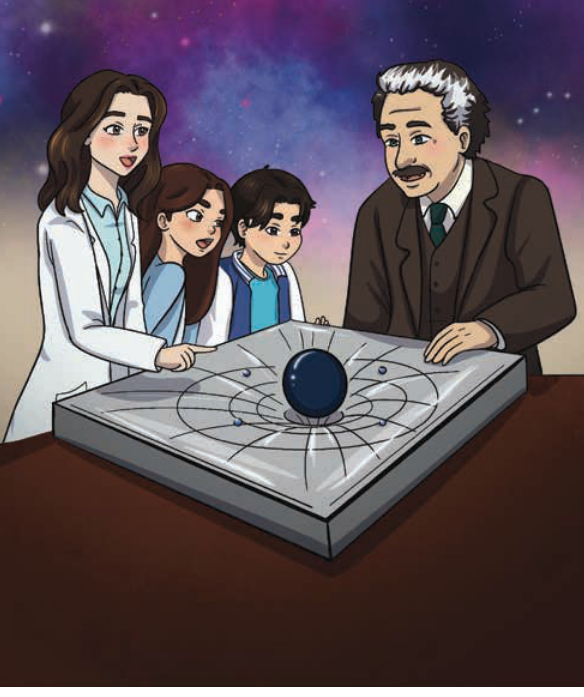
A simple way to picture Einstein’s idea is with a stretched sheet. If you place a heavy ball in the center, the sheet dips. Now roll a marble nearby. The marble curves toward the dip.
The marble is not being pulled by the ball with a string. It is following a path shaped by the curved surface.
In Einstein’s view, space behaves more like that sheet than like an empty stage.
What Curving Space Explains
This model helps explain orbits. A planet is like a marble rolling around a dip. With the right speed and distance, it keeps circling instead of falling straight in.
It also helps explain something even stranger.
Light can bend.
Light does not have mass, so in a simple “pulling” model, it might seem like gravity should not affect it. But if space is curved, light traveling through that space can follow a curved path.
That is one reason Einstein’s theory was so powerful. It explained more than anyone expected.
Why This Is a Relativity Story
Einstein called his theory general relativity because it connected motion, gravity, space, and time into one structure. Space and time are not separate boxes. They are linked.
That means gravity is not just about falling. It is about geometry.
Closing Thought
Einstein reminds us that science is not only about collecting facts. It is about reimagining the world until the rules make sense together.
When you picture gravity as curved space, the universe starts to look less like a machine with hidden strings, and more like a beautiful structure with shape and logic.