

KEAK AUTHOR
Meet The Scientists
Learn About The Scientists:

Galileo Galilei was a curious scientist who loved learning about the universe.
He made one of the first telescopes powerful enough to see details in space, and what he found amazed people everywhere.
When Galileo looked at Jupiter, he noticed four moons circling around it, which helped prove that not everything revolved around Earth as many people believed.
Galileo also discovered that objects of different weights fall at the same speed, an idea that would later shape important scientific laws.
Despite facing criticism, he remained committed to his studies, inspiring scientists to keep exploring and questioning the world around them.

Marie Curie was a brilliant scientist who changed the way we understand radioactivity.
She was born in Poland and later moved to France to study science.
Working with her husband, Pierre, she discovered two new elements, polonium and radium.
Her research helped scientists learn how radiation could be used in medicine.
Marie Curie was the first woman to win a Nobel Prize and is the only person to win in both physics and chemistry.
She worked hard even when facing challenges, and her discoveries continue to inspire scientists around the world today."


Sir Alexander Fleming was a Scottish doctor and scientist born in 1881 who changed the world by discovering penicillin, the first antibiotic.
While working in his lab in London in 1928, he noticed that a mold called Penicillium had killed nearby bacteria on a petri dish, a “lucky accident” that led to the first medicine able to fight many deadly infections.
Fleming also discovered lysozyme, a natural substance in tears and saliva that helps our bodies fight germs.
His work earned him the Nobel Prize in Medicine in 1945 and has saved millions of lives ever since.
Albert Einstein was a brilliant scientist who changed the way we understand space, time, and the universe.
Albert Einstein was a German-born physicist whose ideas transformed how we understand the universe.
He showed that space and time are woven together into a cosmic fabric called spacetime.
He also taught us that light can act like as both waves and particles.
Most important of all he identified the relationship between that mass and energy are two sides of the same equation (E = mc²).
He received the 1921 Nobel Prize in Physics for his work on the photoelectric effect, which helped launch quantum theory.
Even after his fame grew, Einstein remained a teacher and humanitarian who believed that imagination was as important as knowledge.
“Curiosity has its own reason for existing.” — Albert Einstein
Rosalind Franklin was a brilliant scientist who helped uncover the hidden structure of DNA.
She used a powerful technique called X-ray crystallography to take detailed pictures of tiny molecules—too small to see with regular microscopes. Her most famous image, known as “Photo 51,” gave scientists an important clue that DNA has a twisted, ladder-like shape called a double helix.
Rosalind’s careful work helped other scientists understand how DNA carries information inside every living thing, from plants to people.
Even though her contributions were not fully recognized during her lifetime, her discoveries became a key part of one of the most important scientific breakthroughs in history.
Today, Rosalind Franklin is remembered as a pioneer who helped unlock the secrets of life and inspired future scientists to keep exploring.
“Science and everyday life cannot and should not be separated” — Rosalind Franklin
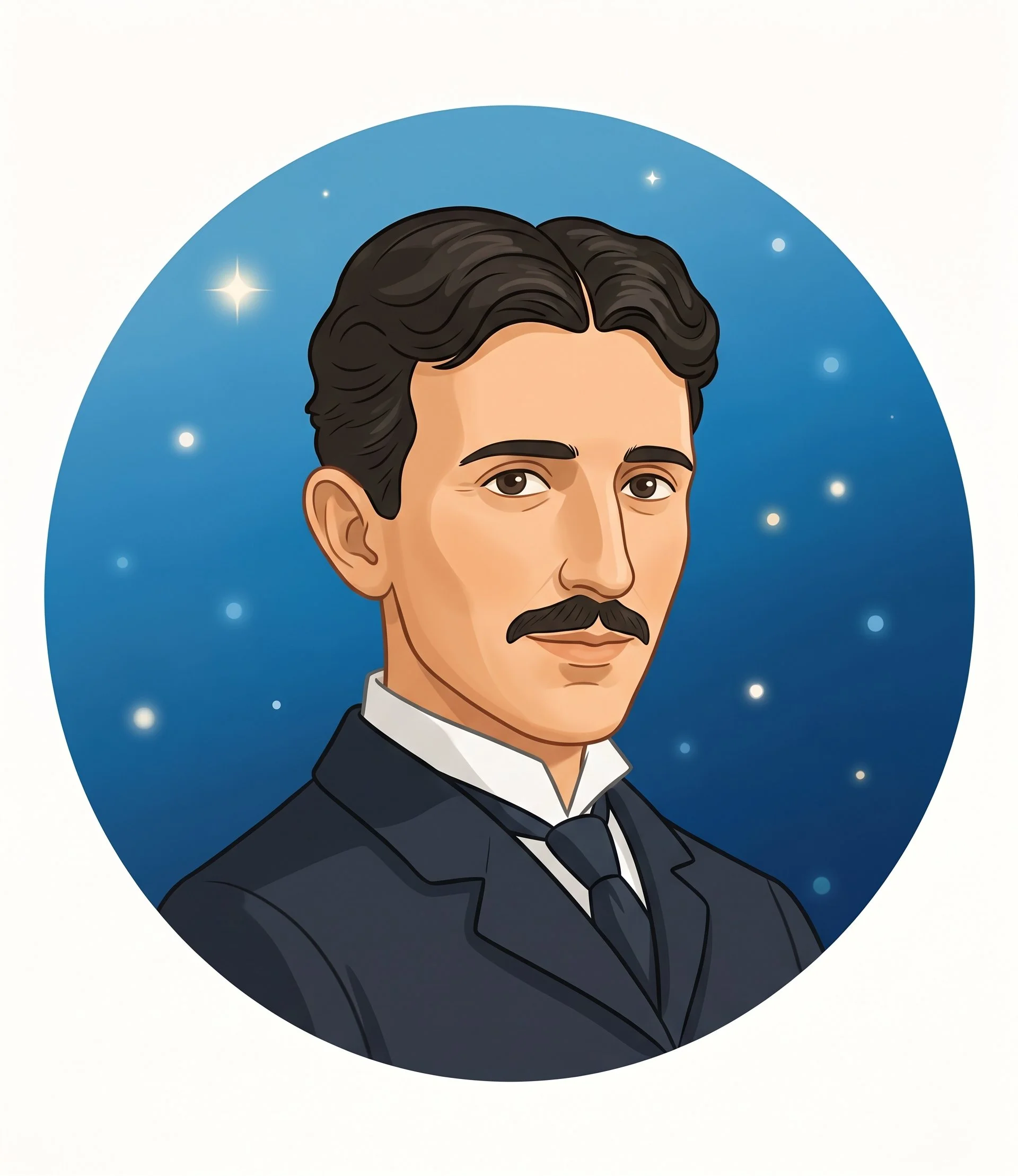
Nikola Tesla was an inventor and electrical engineer whose work helped shape the modern electrical world.
He is best known for his contributions to alternating current, or AC, including systems that used several alternating currents working together and an induction motor that turned electrical energy into motion. Together with advances made by other inventors and engineers, his ideas helped make electrical power practical on a large scale. Tesla also developed the Tesla coil and explored ways to send signals and energy without wires. Some of his plans, including his dream of transmitting electrical power widely without wires, were never fully achieved. In Nikola Tesla’s Electric Dreams, Jennifer and Daniel discover both his accomplishments and the challenges he faced. His story encourages young readers to ask questions, test their ideas carefully, and keep learning when an experiment does not work as expected.