
Build a DNA Double Helix Model
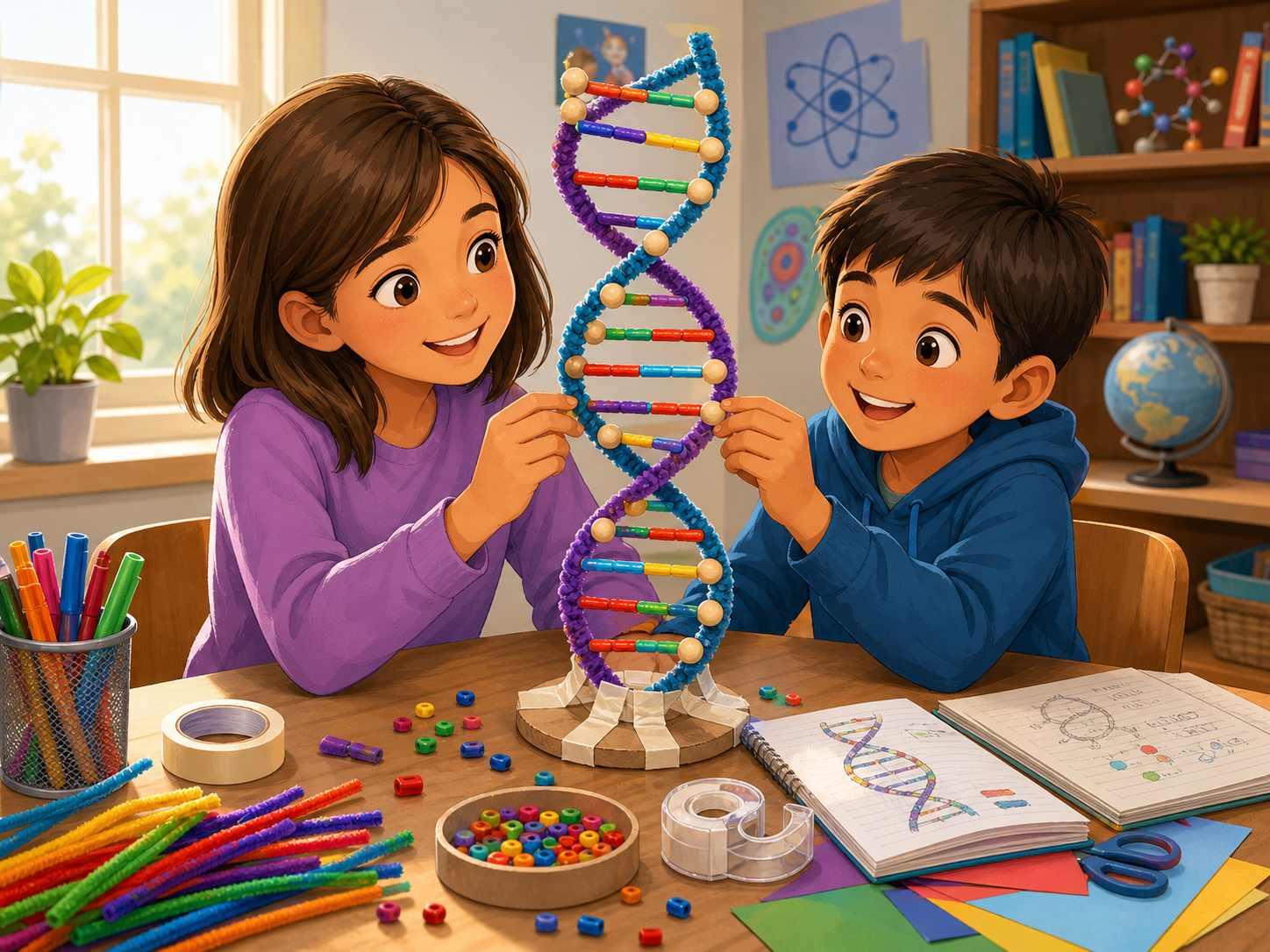
DNA may be too small to see with our eyes, but its shape can be modeled with simple materials. In this hands-on activity, children build a twisting DNA ladder to understand how DNA stores information inside living things.
By creating the sugar-phosphate backbone and matching base pairs, students discover why structure matters in science. Just like Jennifer and Daniel learn in Dr. Franklin’s lab, the shape of DNA helps explain how genetic information can be copied and passed from one generation to the next.
Image suggestion:
Jennifer and Daniel at a table building a colorful DNA model with beads, pipe cleaners, or paper strips.
Materials:
Pipe cleaners or chenille stems, beads or colored paper, tape, scissors, markers, string, index cards.
Experiment / Activity:
Children assign colors to the DNA bases: adenine, thymine, cytosine, and guanine. They pair A with T and C with G, then twist the structure gently to form a double helix.
What children learn:
DNA has a structure. Its parts fit together in a specific way, and that structure helps DNA carry instructions.