
Make a Spacetime Gravity Well
Introduction:
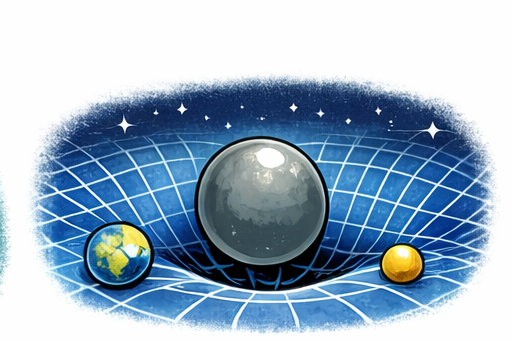
Newton described gravity as a force that pulls things together. Einstein described gravity in a different way. He said that mass can curve space, and objects move along that curved space like marbles rolling on a smooth surface. This idea helps explain why planets orbit and why light can bend near massive objects.
This activity uses a simple model, a stretched fabric “space,” to show how mass can change paths.
What You Will Need:
A stretchy fabric (a fitted sheet or large T-shirt works well)
Four chairs (or a sturdy table)
A heavy ball (basketball, soccer ball, or a large orange)
Two to three small marbles or small round beads
Notebook and pencil
Step-by-Step Instructions:
Stretch the fabric tightly over four chairs so it forms a flat surface.
Place the heavy ball in the center. Watch the fabric curve downward.
Roll a marble slowly near the heavy ball and observe its path.
Roll another marble faster and notice whether it curves, circles, or escapes.
Try rolling from different distances and angles.
Record three trials with a simple sketch of each path.
What to Look For:
How does speed change the marble’s path?
What happens when you roll close versus far away?
Which marble paths look most like an orbit?
Fun Fact:
This model is not perfect because it uses Earth’s gravity to create the dip. It is still useful because it helps our brains picture what curved space might mean.
Safety Tip:
Keep marbles away from very young children and keep them off stairs or hard floors where they can cause slipping.
Journaling Prompt:
If space can curve, what might happen to a beam of light passing near a very massive star? Write your best prediction and explain why.