
When Lightning Becomes a Question
By Katherine E.A. Korkidis
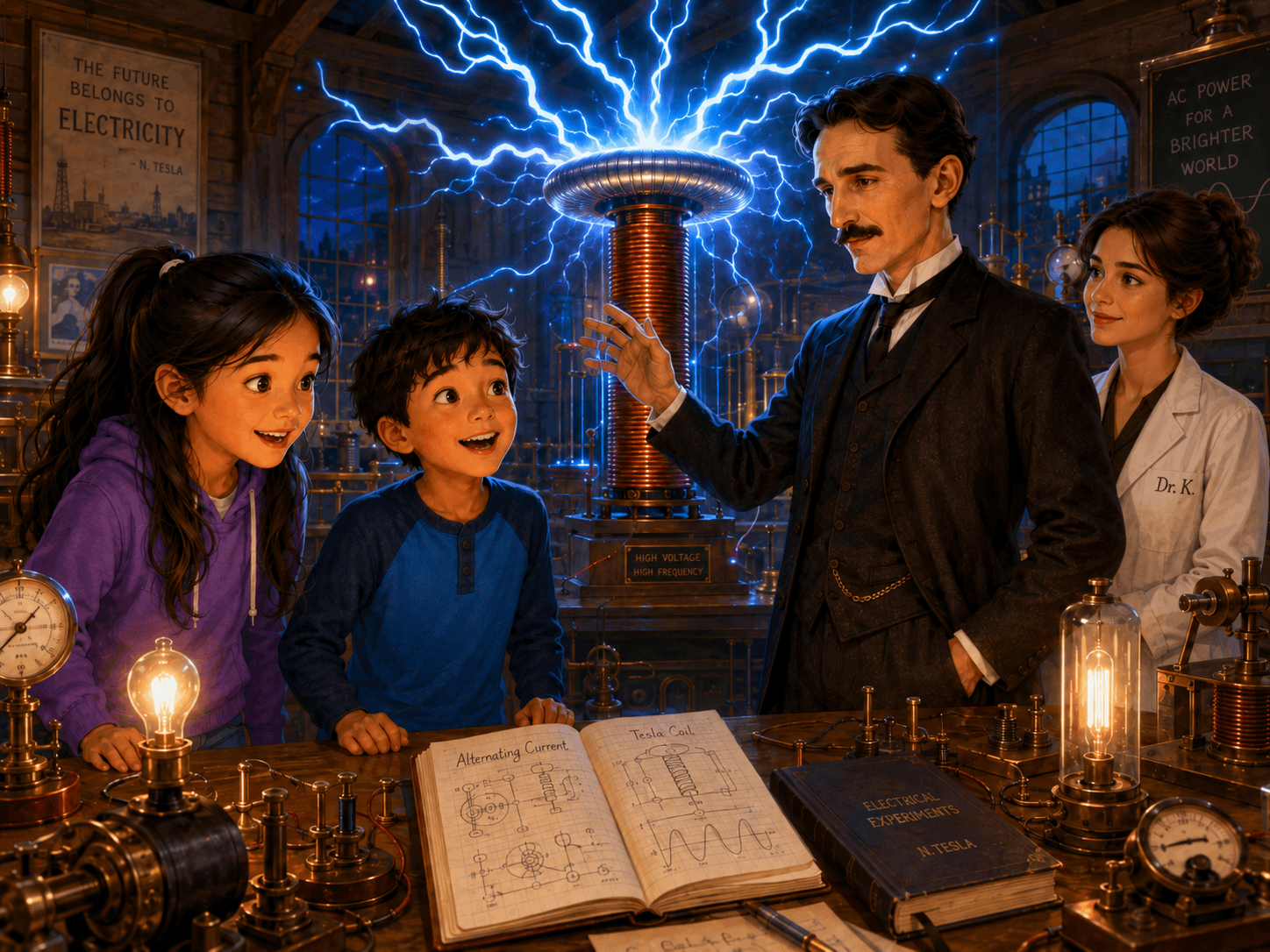
Introducing Nikola Tesla’s Electric Dreams
A storm is never only a storm to a curious child. It is sound, light, interruption, wonder, and sometimes a little fear. In Nikola Tesla’s Electric Dreams, that familiar moment of thunder outside the window becomes the doorway into one of the most unusual minds in scientific history.
Jennifer and Daniel begin where many children begin, not in a laboratory, but in a living room, watching the weather change the mood of the house. The power goes out. Candles are lit. Dr. Liu begins to speak of Nikola Tesla, and suddenly the darkness does not feel empty. It feels charged with possibility.
That is the reason Tesla belongs so naturally in Dr. K’s Portal Through Time. His story is not only about machines, motors, coils, or currents. It is about the rare person who looks at what others accept as ordinary and asks what else might be hidden there. Tesla did not simply use electricity. He listened to it, studied it, imagined its reach, and believed it could reshape the human future.
Children understand this kind of wonder more deeply than adults sometimes realize. They know what it means to stare at lightning and feel that something enormous has happened. They may not yet know the equations, the history, or the engineering behind it, but they recognize mystery. Tesla’s life gives that mystery a name and a path.
In this new adventure, Jennifer and Daniel travel with Dr. K to New York City in 1884, a city alive with horses, street vendors, coal smoke, ambition, and noise. It is not the New York they know. It is a city still becoming itself. Into that world comes Tesla, an immigrant inventor carrying not wealth or certainty, but ideas. He enters a country already hungry for progress, yet not always ready for the kind of future he can see.
This is an important lesson for young readers. Talent does not arrive wrapped in comfort. Brilliance does not guarantee ease. Tesla’s path required discipline, courage, and the lonely strength to continue when others did not yet understand him. For children who feel different, who think deeply, who ask too many questions, or who notice patterns adults overlook, Tesla offers a powerful example. The world may not always understand imagination at first, but imagination can still change the world.
Through Jennifer and Daniel’s eyes, the laboratory becomes more than a room full of wires and strange apparatus. It becomes a place where thought takes shape. A coil of wire is no longer just a coil of wire. A sketch is no longer just a sketch. Each object becomes evidence of persistence, of trial and revision, of a mind reaching beyond the obvious.
Tesla also allows the story to speak honestly about loneliness and recognition. He was admired, doubted, celebrated, resisted, and often misunderstood. That complexity matters. Children do not need flattened heroes. They need human beings who worked, struggled, failed, tried again, and left something meaningful behind. In Tesla, they meet an inventor whose dreams were sometimes larger than the world around him, yet whose work helped bring light into homes, cities, and lives.
The heart of this book is curiosity. Not curiosity as a passing interest, but curiosity as a force strong enough to open doors. Dr. Liu tells Jennifer and Daniel that curiosity has a way of doing exactly that. In this series, it opens a portal. In real life, it opens a mind.
Nikola Tesla’s Electric Dreams invites young readers to look again at the light switch, the power line, the storm outside the window, and the invisible energy that surrounds daily life. It asks them to consider how much of the modern world began as a question in someone’s mind. It reminds them that science is not cold or distant. Science is alive with imagination, patience, courage, and wonder.
And perhaps the next time a storm rolls across the sky, a young reader will not only hear thunder. Perhaps that reader will think of Tesla, of Jennifer and Daniel, of Dr. K, and of the remarkable truth that even darkness can become the beginning of discovery.