
The Current That Carried a City
By Katherine E.A. Korkidis
Why AC and DC Still Matter for Young Readers
Electricity is so woven into ordinary life that most of us barely pause before using it. We enter a room and turn on a light. We charge a phone. We open a refrigerator. We hear the quiet hum of a home filled with unseen power, and we seldom ask how that power traveled to us.
Nikola Tesla’s Electric Dreams asks young readers to pause. It asks them to notice what is usually invisible.
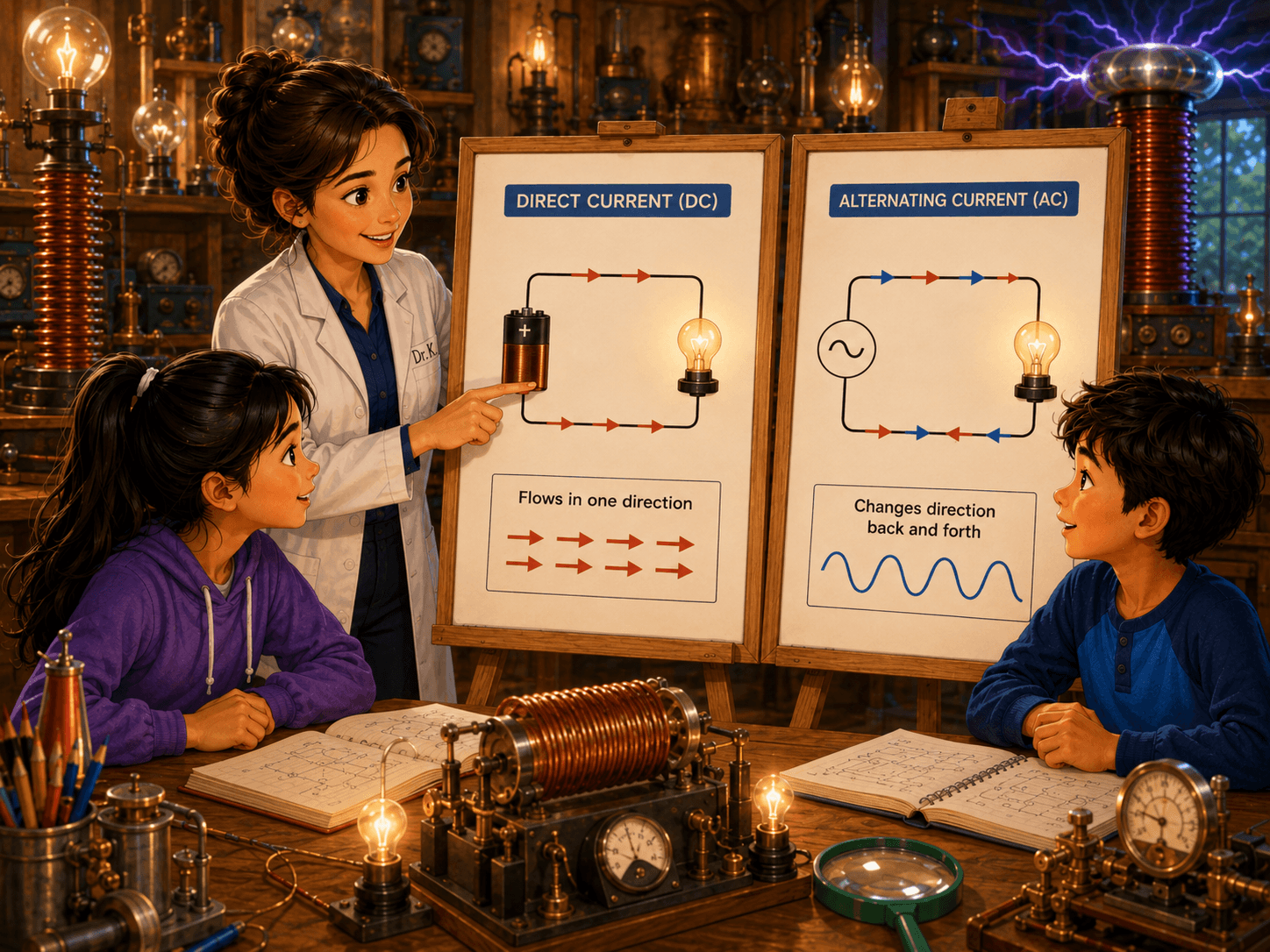
One of the central scientific ideas in the book is the difference between direct current and alternating current. On the surface, this may sound like a lesson from a textbook, but in Tesla’s life it was much more than that. It became part of a fierce historical struggle known as the War of the Currents, a struggle that involved science, business, public trust, fear, ambition, and the future of electrical power.
Direct current, or DC, flows in one direction. It has its uses and remains important today, especially in batteries and many electronic devices. Alternating current, or AC, changes direction periodically. That difference may appear small at first, but it carried enormous consequences. AC could be transformed to higher or lower voltages, making it far more practical for sending electricity over long distances. That meant power could move outward, beyond a few buildings or neighborhoods, toward entire cities and eventually entire regions.
For Jennifer and Daniel, this is not presented as a dry comparison. They have already experienced a power outage at home. They know what it feels like when a familiar room falls suddenly dark. That memory gives the science emotional weight. Electricity is not an abstraction. It is the reason the lamp shines, the refrigerator runs, the city moves, and modern life holds together in ways we rarely examine.
The War of the Currents also gives young readers a valuable historical lesson. Scientific truth does not always win quickly. Better ideas still need advocates. They need evidence. They need courage. They often meet resistance because people have money, pride, reputation, and habit invested in older ways of doing things. That is one of the more honest lessons in Tesla’s story. Progress is not simply a matter of inventing something new. Progress must often persuade a world that does not want to change.
Tesla believed that AC could serve humanity on a larger scale. Thomas Edison supported DC and had built systems around it. George Westinghouse saw the promise in Tesla’s work and helped bring AC power into broader use. This conflict was not only about wires. It was about which vision of the future would reach ordinary people.
In the book, Dr. K helps Jennifer and Daniel understand that science belongs in context. A discovery does not float above society. It enters a world of newspapers, businesses, public demonstrations, investors, fears, and hopes. That is a sophisticated truth, and children are capable of understanding it when it is presented with clarity and respect.
The Chicago World’s Fair becomes one of the most memorable examples. Imagine standing in a place where electric light does not merely illuminate a room, but astonishes a crowd. Imagine seeing a system that had been debated, doubted, and challenged suddenly displayed on a grand scale. For Jennifer and Daniel, such a moment becomes more than spectacle. It becomes proof that an idea can move from a private conviction to a public transformation.
This is why Tesla remains such a compelling figure for middle grade readers. His work touches something they encounter every day, yet his life opens a much larger conversation. How do we know when an idea is worth defending? How do we continue when others disagree? How do we balance safety, ambition, practicality, and imagination? These are scientific questions, but they are also human questions.
Nikola Tesla’s Electric Dreams brings AC and DC to life by showing the people and pressures behind the concepts. Young readers learn what current is, but they also learn what conviction looks like. They see that a system powerful enough to light cities began with human thought, human risk, and human persistence.
That is the kind of science story children remember. Not only the definition. Not only the diagram. The story behind the light.