
Tesla’s Wireless Dream
By Katherine E.A. Korkidis
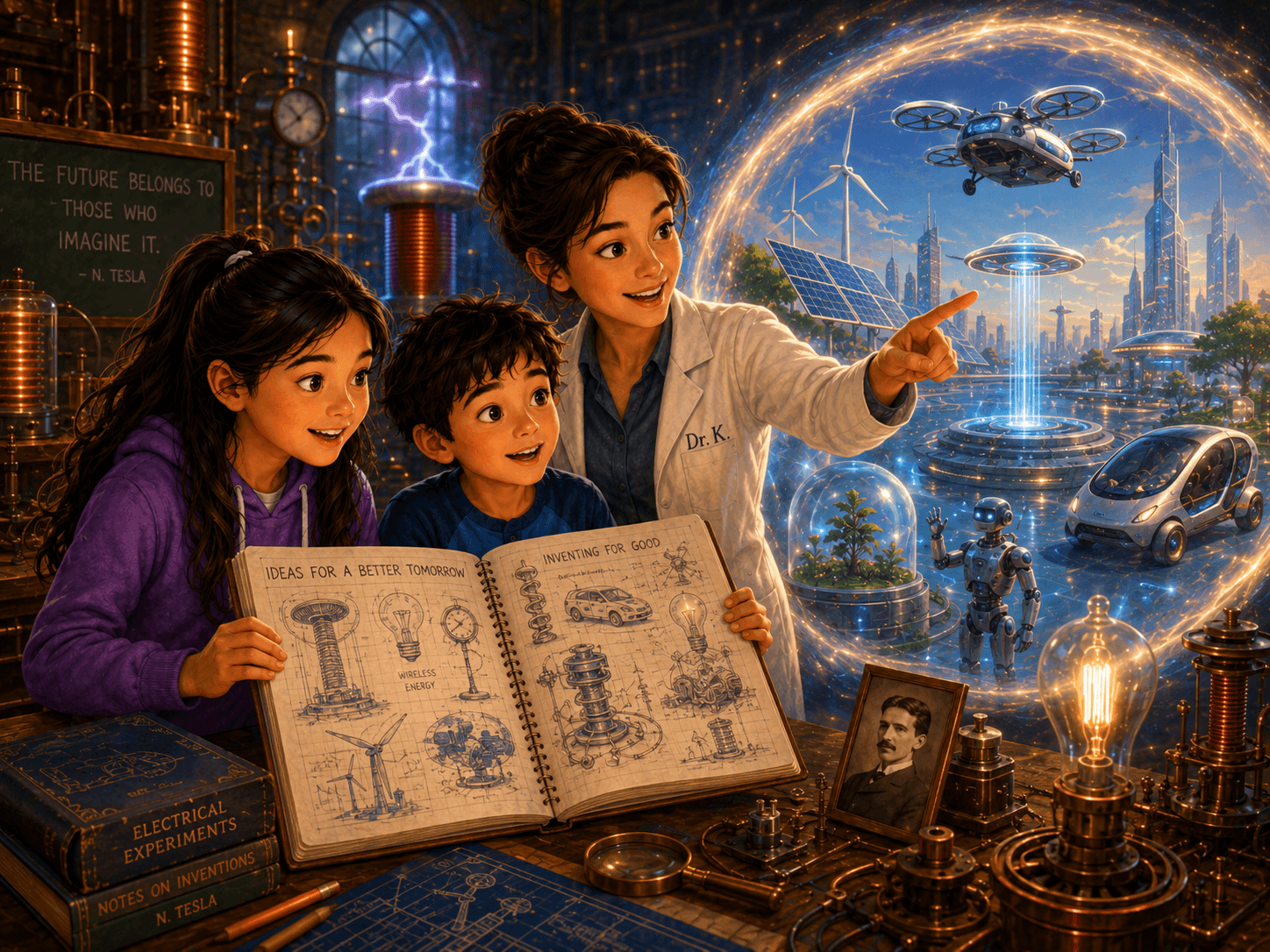
The Courage to Imagine Beyond the Present
Some ideas sound impossible only because the world has not caught up with them yet. Nikola Tesla lived in that difficult space between what people could understand and what he believed might one day be possible.
In Nikola Tesla’s Electric Dreams, this tension becomes one of the most meaningful parts of the journey. Jennifer and Daniel do not meet Tesla merely as an inventor of the past. They meet a man whose mind is already leaning toward the future. He speaks of wireless energy, electromagnetic waves, communication across distance, and the power of natural forces. He sees not only what electricity can do in a laboratory, but what it might someday do for the world.
For children growing up in a wireless age, this part of Tesla’s story has special power. They live with devices that charge, connect, speak, send, receive, and communicate without visible wires. Yet most children do not often stop to consider that such conveniences began with people who dared to imagine invisible systems long before they became familiar. Tesla’s dream helps young readers understand that modern technology did not appear fully formed. It came from questions, experiments, failures, refinements, and visions that once seemed too bold.
Tesla’s work with the Tesla coil gives the book one of its most vivid scientific moments. Sparks leap. Light cracks through the air. Jennifer and Daniel feel awe before they understand the explanation. That order matters. Wonder often comes first. Understanding follows when a patient teacher helps the mind approach what the eye has already admired.
Through Tesla and Dr. K, readers learn that the coil is not magic. It is science. It uses electromagnetic induction. It involves coils, current, magnetic fields, voltage, and air changed enough for electricity to pass through it. Yet explaining the science does not remove the wonder. It deepens it. The more the children understand, the more remarkable the demonstration becomes.
That is one of the quiet strengths of this series. It refuses to choose between beauty and accuracy. A child can feel astonishment and still learn the principle. A laboratory can be dramatic without becoming fantasy. A historical figure can be inspiring without being made perfect.
Tesla’s wireless dream also allows young readers to think about the responsibility of invention. He believed science should serve a better future. He was interested in energy, communication, and the possibility of reaching people more broadly. In the book, this idea reaches beyond the machine itself. It asks what invention is for. Is it only to build something impressive? Or is it to make life better, wider, more connected, and more humane?
These are rich questions for a classroom, a family discussion, or a young reader sitting alone with a book. They invite children to see themselves not only as learners, but as future builders. The future is not an abstract place waiting somewhere far ahead. It is shaped every day by the questions people choose to ask and the problems they are brave enough to approach.
Tesla’s story also gives permission to think differently. Many young readers carry ideas they do not yet know how to explain. Some sketch inventions in notebooks. Some take apart toys to see how they work. Some notice patterns in weather, machines, music, stars, or numbers. Tesla reminds them that unusual thinking can be a gift, provided it is joined to discipline, study, and persistence.
Jennifer and Daniel leave Tesla with more than facts. They carry a new understanding of imagination as a serious act. To imagine is not to drift away from reality. For an inventor, imagination is the first step toward changing reality. Tesla looked at the invisible and asked whether it could become useful. He looked at power and asked whether it could travel farther. He looked at the present and refused to believe it was the limit.
That may be the finest lesson Nikola Tesla offers young readers today. The world they inherit was imagined before it was built. The world they will help create may begin the same way, with a question no one else has asked yet, a spark no one else has followed, or a dream bright enough to keep glowing long after the room goes dark.